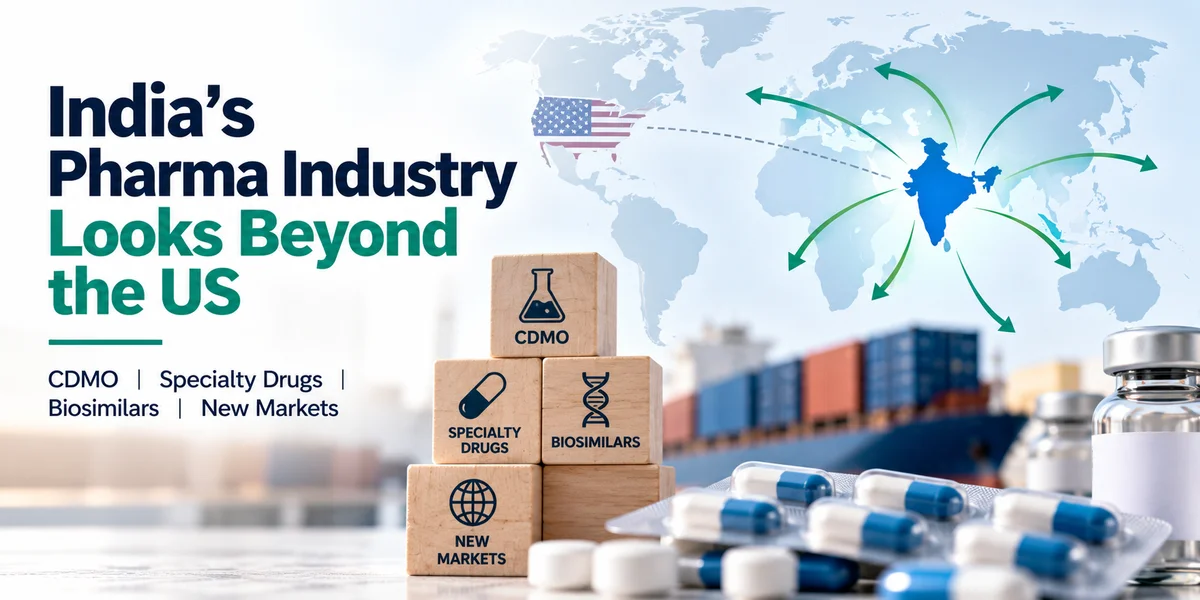
“India Pharma Looks Beyond the US” CDMO • Specialty Drugs • Biosimilars • New Markets
India's pharma industry is diversifying beyond US generics, with growing opportunities in CDMO, specialty medicines, biosimilars and emerging markets.

PharmaNation | Pharma Industry Analysis
For decades, the United States has been the most important overseas market for Indian pharmaceutical companies.
Indian drugmakers built a powerful position in the US through affordable generic medicines, helping establish India as one of the world's leading pharmaceutical manufacturing hubs.
But the industry's growth story is beginning to change.
Increasing pricing pressure in US generics, regulatory scrutiny, patent expiries and geopolitical uncertainty are encouraging Indian pharmaceutical companies to look beyond the traditional generic-drug model.
The next phase of India's pharma story could increasingly be driven by specialty medicines, biosimilars, complex generics, contract development and manufacturing, and expansion into emerging global markets.
The US Is Still Critical—but the Equation Is Changing
The US remains India's largest pharmaceutical export destination.
India exported approximately $9.46 billion worth of pharmaceuticals to the US in FY26, accounting for around 30.4% of India's total pharmaceutical exports. However, exports to the US declined from the previous year's level, reflecting pressure in the generic-drug market.
This does not mean Indian pharma companies are abandoning the US.
Quite the opposite.
Indian companies continue to invest in the American market, but increasingly through specialty products, complex generics, injectables, biosimilars, local manufacturing and higher-value therapies rather than relying exclusively on conventional oral generics.
That distinction could become one of the defining themes of Indian pharma over the next decade.
Why Companies Are Looking for New Growth Engines
The traditional generic business remains enormous, but it has become increasingly competitive.
Multiple manufacturers may compete for the same molecule after patent expiry, creating intense price competition.
At the same time, regulatory compliance costs have increased, while consolidation among large buyers has put additional pressure on prices.
This has encouraged pharmaceutical companies to move towards products and services where technology, intellectual property, manufacturing complexity and regulatory capabilities create stronger barriers to competition.
Industry analysts increasingly identify CDMO/CRDMO, biosimilars and specialty medicines as important areas for future growth.
CDMO: India Wants to Become the World's Development Partner
One of the biggest opportunities is the growth of the Contract Development and Manufacturing Organisation (CDMO) sector.
Under the CDMO model, pharmaceutical and biotechnology companies outsource parts of drug development and manufacturing to specialist companies.
India has several advantages in this space:
A large pool of scientific and technical talent
Competitive manufacturing costs
Established pharmaceutical infrastructure
Experience with global regulatory requirements
A strong chemicals and API ecosystem
Growing capabilities in biologics and complex manufacturing
Global pharmaceutical companies are also looking to diversify their supply chains.
That creates an opportunity for Indian companies to capture more international development and manufacturing contracts.
Recent investments and business announcements in India's CDMO sector demonstrate that companies are moving towards increasingly complex products, including biologics, peptides, sterile injectables and other specialised therapies.
Specialty Medicines Could Change the Industry's Economics
Another major shift is towards specialty pharmaceuticals.
Specialty medicines generally involve more complex development, manufacturing or clinical requirements and can target specific diseases or patient populations.
Indian companies are increasingly investing in areas such as:
Oncology | Respiratory | Neurology | Immunology | Dermatology | Metabolic Diseases | Rare Diseases
The move towards specialty products can potentially improve margins and reduce dependence on highly commoditised generic medicines.
Industry commentary from major Indian companies, including Sun Pharma, Dr Reddy's Laboratories, Cipla and Lupin, indicates a broader shift towards specialty medicines, biosimilars, chronic therapies and geographically diversified businesses.
Biosimilars: Another Long-Term Opportunity
Biological medicines have transformed treatment for many serious diseases, but their high cost creates significant healthcare challenges.
As patents for several biological therapies expire, biosimilars are expected to become increasingly important.
For India, this represents a potentially large opportunity.
Indian companies already possess significant experience in biologics manufacturing and complex pharmaceutical development. The country's cost advantages could help Indian manufacturers compete in international biosimilar markets.
The Indian Pharmaceutical Alliance has also highlighted complex generics, biosimilars and specialty products as important areas for the sector's future growth.
Emerging Markets Are Becoming More Important
The US isn't the only opportunity.
Indian pharmaceutical companies are also expanding their presence across:
Europe
Africa
Latin America
Southeast Asia
Middle East
Other emerging markets
India's pharmaceutical exports reached a record $31.12 billion in FY26, although growth slowed to around 2.1% as shipments to the US weakened. Increased contributions from markets including Europe and Africa helped offset some of the weakness.
This geographical diversification could become increasingly important if trade barriers or pricing pressure in developed markets intensify.
India's Domestic Market Is Becoming a Bigger Growth Driver
There is another important part of the story: India itself.
The domestic pharmaceutical market has been showing strong growth.
According to recent industry estimates, India's pharma sector could grow by around 10% in FY27, supported by domestic demand, CDMO activity and recovery in the API segment. The domestic market grew strongly during the April-June 2026 quarter among companies tracked by India Ratings.
Chronic therapies—including cardiovascular, diabetes and other long-term treatments—are becoming increasingly important as India's healthcare needs evolve.
For pharmaceutical companies, therefore, the future may not be about choosing between India and international markets.
It could be about building multiple growth engines simultaneously.
The China Factor
India's opportunity also needs to be viewed in the context of global supply-chain diversification.
China remains an important part of the global pharmaceutical supply chain, particularly for APIs and starting materials.
However, pharmaceutical companies in the US and other markets are increasingly examining supply-chain resilience and alternative manufacturing locations.
This could create additional opportunities for India in API manufacturing, contract manufacturing and pharmaceutical development.
But the opportunity is not automatic.
India will need to remain competitive on quality, scale, reliability, technology and regulatory compliance.
The Biggest Challenge: Moving From Volume to Value
India's pharmaceutical success has historically been built on scale and cost efficiency.
The next phase will require something more.
Indian companies will increasingly need to invest in:
R&D + Innovation + Complex Manufacturing + Intellectual Property + Regulatory Excellence
This transition will not happen overnight.
Developing a specialty medicine, biosimilar or innovative therapy requires significantly more investment and technical expertise than manufacturing a conventional generic.
The companies capable of making this transition successfully could potentially emerge as the strongest global Indian pharma players.
What Could India's Pharma Industry Look Like in 2030?
If current trends continue, India's pharmaceutical industry could look considerably different by the end of the decade.
The sector could have:
Fewer commodity-focused businesses and more specialised manufacturers.
More CDMO and CRDMO partnerships with global pharma companies.
Greater participation in biosimilars and complex biologics.
A stronger presence in specialty medicines.
More geographically diversified exports.
Greater domestic R&D and innovation capabilities.
The traditional generic business will remain important—but it may no longer be the entire story.
PharmaNation View
India does not need to choose between being the “pharmacy of the world” and becoming an innovation-driven pharmaceutical powerhouse.
The bigger opportunity may be to build on its existing strengths while moving gradually up the value chain.
India already has the manufacturing base, scientific talent and global pharmaceutical relationships.
The challenge now is to convert those advantages into higher-value products, stronger intellectual property, advanced manufacturing capabilities and globally competitive innovation.
The next chapter of Indian pharma may therefore be less about how many medicines India manufactures and more about how much value India creates from them.
The Bottom Line
The US will remain an important market for Indian pharmaceutical companies.
But India's future pharmaceutical growth is likely to be increasingly diversified across specialty medicines, biosimilars, CDMO/CRDMO services, complex generics, domestic healthcare demand and emerging international markets.
For India's pharma industry, the strategic direction appears increasingly clear:
From volume to value.
From generics to complexity.
From manufacturing to innovation.
And that could be one of the most important transformations in India's pharmaceutical story over the coming decade.
This article is an industry analysis based on publicly available industry data and recent reports. Market conditions, trade policies and company strategies can change rapidly.
Follow PharmaNation for pharmaceutical industry news, regulatory updates, business developments and market analysis.
The editors of this publication. Replace with your real editors in News Desk → Authors.
More from this section

The Practical Antibiotic Handbook by PharmaNation ( DOWNLOAD E-BOOK )
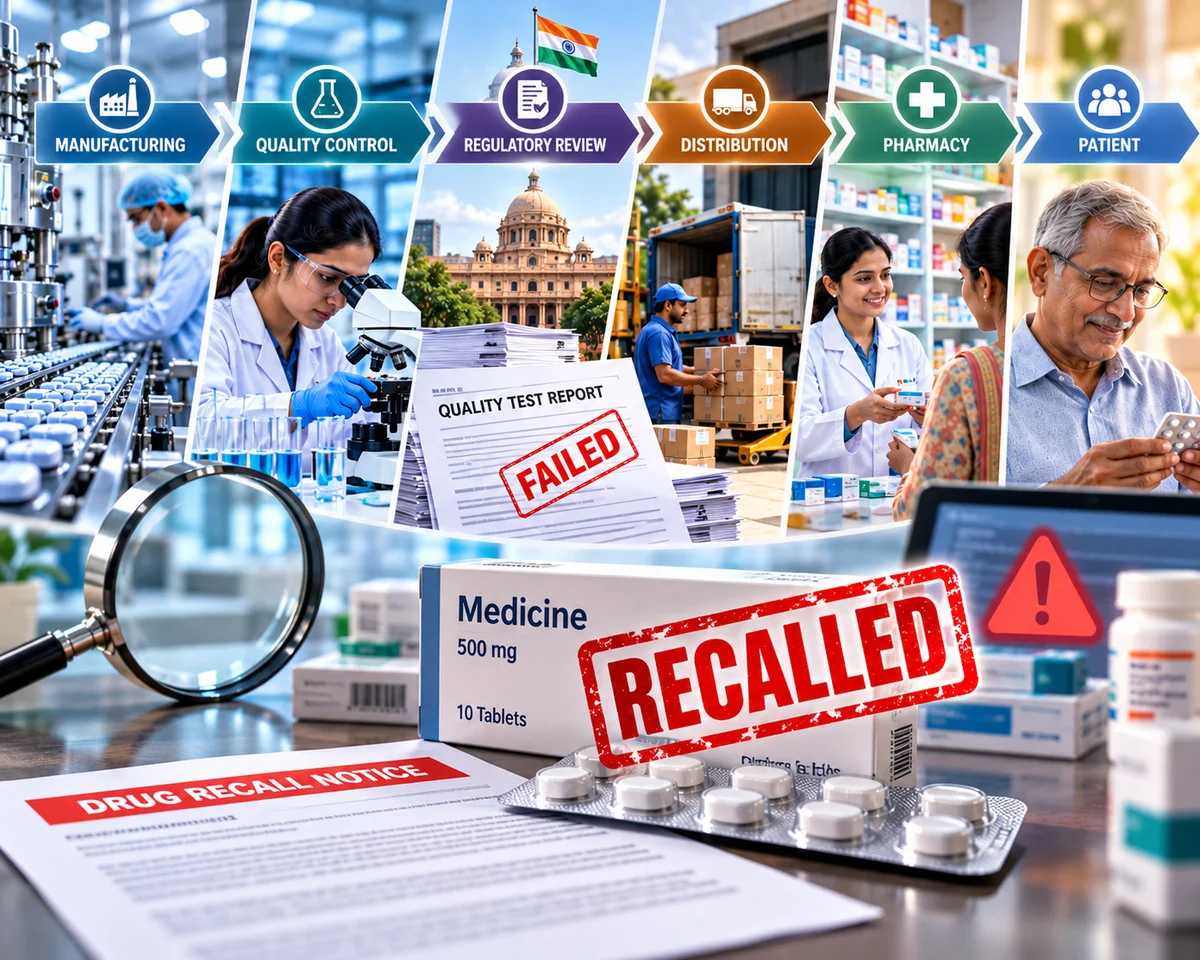
Drug Recall in India: What Happens When a Medicine Fails a Quality Test?

Drug Regulations in India: Rules, CDSCO, Schedules & Pharmacy Compliance