India’s Generic Drug Market: Who Makes Money at Each Stage of the Supply Chain?
Explore India’s generic drug supply chain and discover how manufacturers, C&F agents, distributors, wholesalers and pharmacies make money.

India is often described as the “pharmacy of the world”, and for good reason. The country has a vast pharmaceutical manufacturing base, a large domestic medicine market and a distribution network that reaches from major cities to small towns and rural markets.
But when a patient buys a ₹100 strip of medicine from a pharmacy, a simple question often goes unanswered:
Where does that ₹100 actually go?
The answer involves far more businesses than the pharmaceutical manufacturer whose name appears on the package.
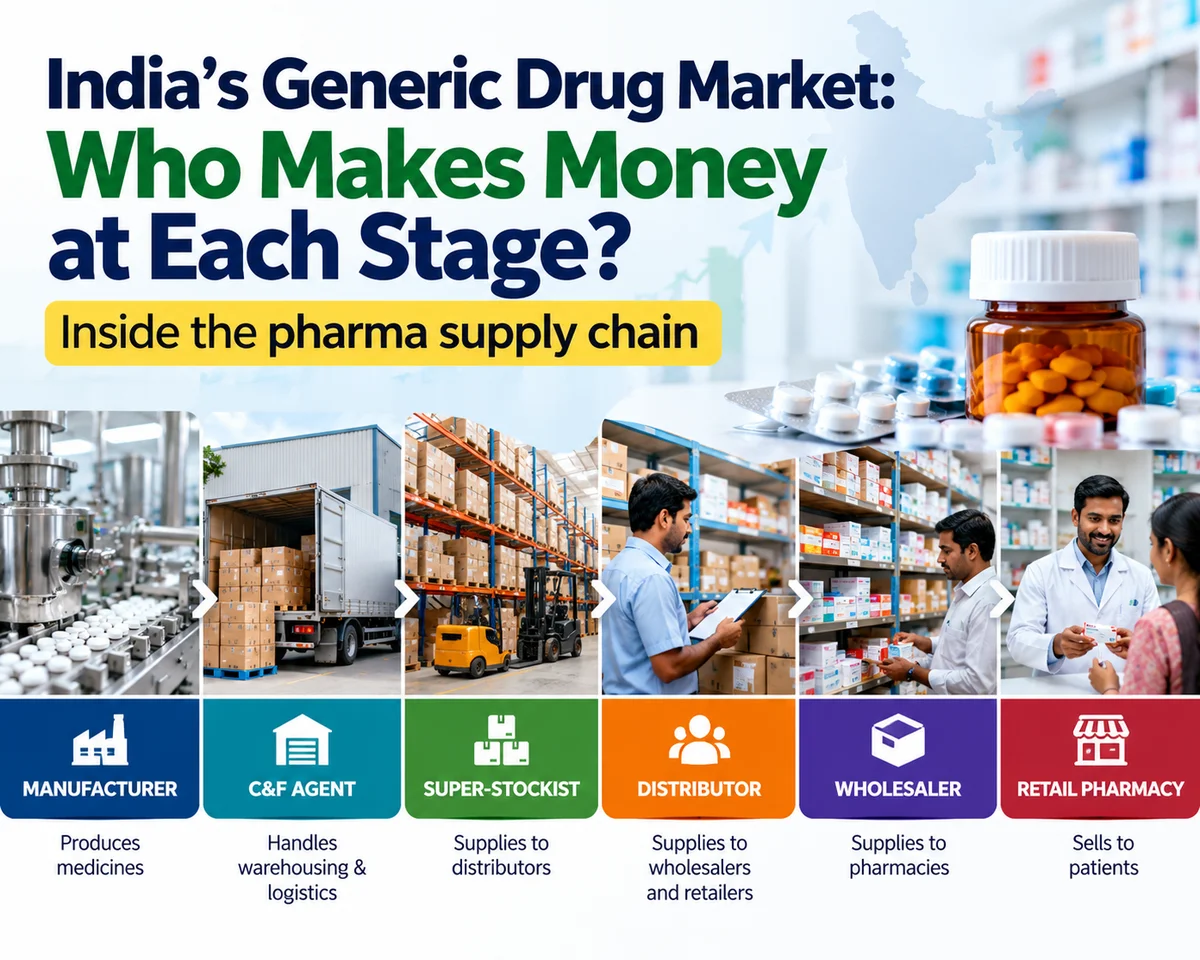
Between the factory and the patient, there can be manufacturers, carrying-and-forwarding agents, super-stockists, distributors, wholesalers and retailers—each playing a different role and operating with different economics.
Understanding this supply chain is essential for anyone looking at India's pharmaceutical business.
1. The Manufacturer: Where the Journey Begins
The pharmaceutical manufacturer is the first major player in the chain.
A company may manufacture medicines under:
Its own brand
A generic name
A contract manufacturing arrangement
A third-party manufacturing agreement
A loan-licence arrangement, depending on the regulatory structure
Manufacturing involves much more than simply producing tablets.
Companies have to manage:
Active pharmaceutical ingredients (APIs)
Excipients
Packaging materials
Quality control
Regulatory compliance
Manufacturing infrastructure
Labour
Research and development
Marketing
Inventory
Large manufacturers can benefit from economies of scale, while smaller companies may focus on specific therapeutic segments or outsource production.
But manufacturing is only the beginning.
2. The C&F Agent: Moving the Stock
Many pharmaceutical companies use carrying and forwarding (C&F) agents to manage regional inventory and logistics.
The C&F agent generally acts as an operational link between the manufacturer and downstream distributors.
Its responsibilities can include:
Receiving stock from the manufacturer
Warehousing
Maintaining inventory
Processing dispatches
Managing documentation
Sending goods to appointed distributors
The C&F model allows pharmaceutical companies to maintain a wide distribution network without directly managing every warehouse and dispatch operation themselves.
For the C&F operator, the business is generally more about volume, infrastructure and operational efficiency than high margins on individual products.
3. The Super-Stockist: Regional Scale
In some distribution structures, the next layer may be a super-stockist.
The super-stockist purchases or receives substantial quantities and supplies smaller distributors or stockists in a defined territory.
This layer becomes particularly useful when a pharmaceutical company wants deep market penetration across multiple cities or districts.
The economics are based heavily on:
High volume + inventory turnover + efficient working capital management.
A distributor handling ₹1 crore of stock at relatively modest margins may generate more absolute business than a small operator working with significantly higher margins on a much smaller turnover.
That is one of the defining characteristics of pharmaceutical distribution.
4. The Distributor or Stockist
This is one of the most important links in the Indian pharma supply chain.
The distributor buys medicines from the company or an upstream channel partner and supplies them to pharmacies, hospitals, clinics and other authorised customers, depending on the product and applicable regulations.
The distributor has to manage several challenges simultaneously:
Inventory
Thousands of SKUs may need to be maintained.
Expiry
Medicines have limited shelf lives. Slow-moving inventory can turn into a direct financial loss.
Credit
Retailers may purchase on credit, meaning the distributor's money can remain tied up for weeks or months.
Schemes and discounts
Pharma distribution frequently operates with trade schemes, incentives and commercial discounts.
Returns
Expired, damaged or unsold products can create additional operational complexity.
As a result, turnover alone does not determine profitability.
A distributor with ₹5 crore in annual sales is not necessarily more profitable than one with ₹3 crore.
The real questions are:
What is the gross margin? How quickly does inventory move? How much credit is outstanding? How much stock expires? And how efficiently is working capital managed?
5. The Wholesaler
Wholesalers operate between manufacturers/distributors and downstream customers such as pharmacies and other authorised buyers.
In India's fragmented healthcare market, wholesalers can play a particularly important role in supplying smaller pharmacies that cannot purchase directly from every pharmaceutical company.
A retailer may need medicines from hundreds of companies.
Maintaining direct relationships with every manufacturer would be impractical.
The wholesaler solves this problem by providing availability and consolidation.
For the retailer, the value proposition is simple:
One supplier → many brands → faster replenishment.
6. The Retail Pharmacy: The Final Commercial Link
The retail pharmacy is where the supply chain finally meets the consumer.
The pharmacy has several costs that aren't immediately visible in the medicine's MRP:
Shop rent
Salaries
Electricity
Software and billing
Inventory financing
Expired stock
Delivery
Compliance costs
Taxes and accounting
Discounts offered to customers
A pharmacy therefore cannot look at the difference between purchase price and selling price as pure profit.
Its actual net profitability depends on the entire cost structure.
And this is why inventory turnover can be just as important as margin.
A medicine that gives a pharmacy a smaller margin but sells rapidly may contribute more to the business than a high-margin product that remains on the shelf for months.
So Who Makes the Most Money?
This is where the pharma supply chain becomes interesting.
There is no universal answer.
A manufacturer may generate large absolute profits because of scale.
A distributor may operate on relatively modest margins but achieve substantial turnover.
A retailer may earn a higher percentage on selected products but face much higher operating expenses.
A specialised or niche product may provide a very different commercial return from a high-volume commodity generic.
Therefore, looking only at the percentage margin can be misleading.
A simplified example
Imagine a medicine with an MRP of ₹100.
The manufacturer may sell it into the trade channel at a substantially lower price after considering applicable commercial structures.
The subsequent participants may receive their respective trade margins, discounts or schemes.
By the time the medicine reaches the pharmacy, the economics have already been divided among multiple participants.
The exact numbers vary significantly by product, company, category, channel and applicable pricing rules.
That's why there is no single "standard pharma margin" that applies to every medicine in India.
The Hidden Cost: Working Capital
One of the biggest challenges in pharma distribution isn't margin.
It's cash flow.
Suppose a distributor sells ₹1 crore worth of medicines but allows substantial credit to retailers.
The distributor may have already paid the manufacturer while still waiting to collect money from customers.
This creates a working-capital gap.
At the same time, inventory continues to sit in the warehouse.
If payment cycles become longer, even a profitable business can experience financial stress.
This is why experienced pharma distributors closely monitor:
Inventory days + receivable days + payable days.
Cash-flow discipline can make or break the business.
Expiry Is Another Major Risk
Unlike many general FMCG products, medicines have expiry dates that require careful inventory management.
A slow-moving product can remain in the warehouse until it approaches expiry.
This creates several risks:
Financial loss
Return management
Replacement negotiations
Inventory write-offs
Regulatory and operational complications
The best distributors therefore don't simply ask:
"What has the highest margin?"
They also ask:
"What actually moves?"
Why Generic Medicines Change the Economics
Generic medicines add another dimension to the market.
When multiple companies sell products containing the same active ingredient, competition increases.
Companies may compete through:
Price
Brand recognition
Distribution strength
Doctor outreach
Retailer relationships
Product availability
Packaging
Trade schemes
Service
For wholesalers and pharmacies, availability can sometimes be as important as price.
A medicine that is competitively priced but frequently unavailable is difficult to build a reliable business around.
The Digital Disruption
The traditional supply chain is also being challenged by technology.
Digital ordering platforms, e-pharmacies, inventory-management systems, online B2B marketplaces and direct-to-pharmacy models are changing how medicines are ordered and supplied.
A retailer can increasingly:
Compare suppliers
Check stock
Place orders digitally
Track invoices
Monitor inventory
Analyse sales
Reduce manual paperwork
This doesn't necessarily eliminate traditional distributors.
Instead, the role of the distributor may evolve from simply moving boxes to providing a broader combination of:
availability + credit + logistics + technology + service.
What Happens Next?
India's pharmaceutical supply chain is likely to become more organised and data-driven.
The traditional model will continue to remain important because India's pharmacy network is enormous and geographically diverse.
But the competitive advantage is changing.
Tomorrow's successful pharma distributor may not simply be the one offering the lowest price.
It may be the one that can provide:
better availability, faster delivery, lower expiry, tighter inventory control, reliable credit and better technology.
For manufacturers, meanwhile, the challenge will be to balance market reach with pricing, brand investment and distribution efficiency.
And for retailers, the key question will increasingly be:
How can I improve profitability without compromising availability, compliance or customer trust?
The Bottom Line
India's generic drug market is not just a story about cheap medicines.
It is a massive business ecosystem involving manufacturing, logistics, distribution, wholesale and retail.
Every ₹100 medicine sold at the pharmacy represents a chain of commercial decisions that began much earlier at the manufacturing plant.
And as the Indian pharmaceutical market becomes more competitive and digital, the biggest winners may not necessarily be the businesses with the highest margins.
They may be the businesses that manage scale, inventory, cash flow and customer relationships the best.
PharmaNation View:
The future of India's pharma distribution business will be shaped by a simple equation: better efficiency + better availability + smarter working capital = stronger pharmaceutical businesses.
The editors of this publication. Replace with your real editors in News Desk → Authors.
More from this section

The Practical Antibiotic Handbook by PharmaNation ( DOWNLOAD E-BOOK )
Drug Recall in India: What Happens When a Medicine Fails a Quality Test?
Drug Regulations in India: Rules, CDSCO, Schedules & Pharmacy Compliance