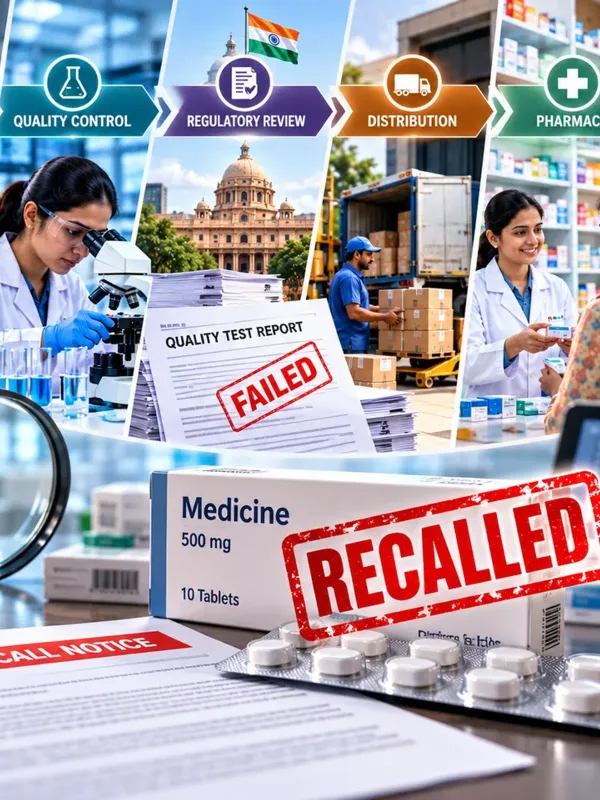
Drug Recall in India: What Happens When a Medicine Fails a Quality Test?
What happens when a medicine fails a quality test? Learn about NSQ drugs, recalls, batch numbers, CDSCO alerts and what manufacturers, distributors and pharmacies must do.
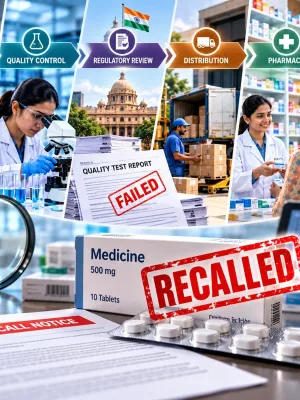
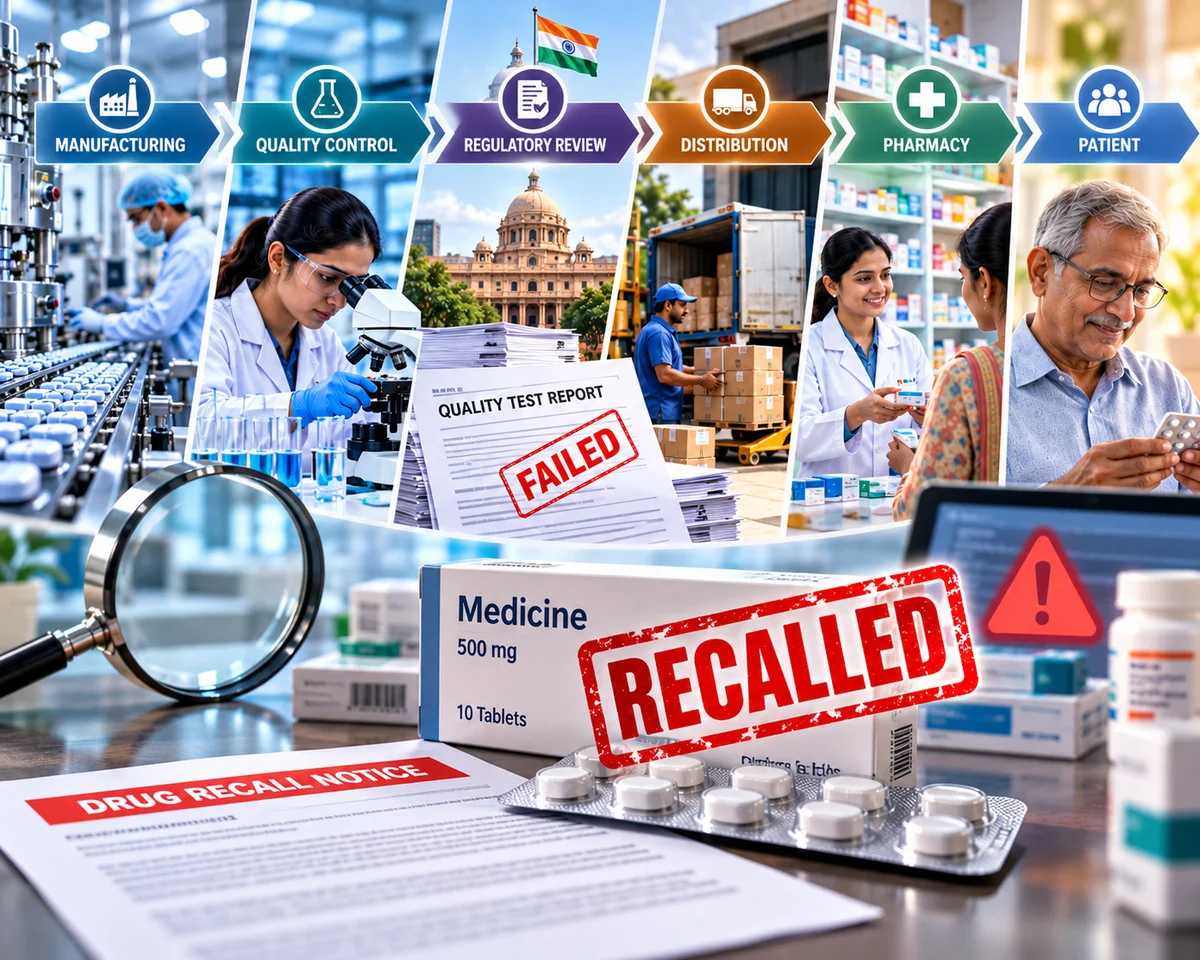
A medicine reaches a pharmacy only after passing through several stages of manufacturing, testing, licensing and distribution. But what happens if a medicine is later found to have a quality problem?
The answer is drug recall.
A medicine may need to be withdrawn because it is Not of Standard Quality (NSQ), spurious, adulterated, defective, unsafe or otherwise unsuitable for continued distribution or use.
For manufacturers, distributors and pharmacists, a recall is much more than simply removing a few boxes from a shelf. It involves tracing the affected batch, stopping further distribution, recovering stock and documenting what happened.
For patients, understanding drug recalls can help answer an important question:
How does the pharmaceutical system protect them when something goes wrong?
What Is a Drug Recall?
A drug recall is an action taken to withdraw or remove a medicine from distribution or use because of a quality, safety or efficacy concern.
CDSCO's recall guidance covers products associated with quality defects such as NSQ, adulterated or spurious drugs, as well as recalls related to serious safety or efficacy concerns. Recalls may be voluntary or statutory.
A recall can therefore occur for different reasons.
For example:
The medicine fails a laboratory quality test.
The product contains the wrong quantity of an active ingredient.
The product fails a dissolution or assay test.
Contamination is detected.
Packaging or labelling is incorrect.
A serious safety issue is identified.
A product is found to be spurious.
A manufacturing defect affects a particular batch.
The important point is that a recall generally concerns a specific product, batch or defined group of products rather than automatically meaning that every product made by a company is defective.
What Does NSQ Mean?
One term frequently seen in India's drug alerts is NSQ — Not of Standard Quality.
A drug can be declared NSQ when testing shows that it does not meet the applicable quality specifications.
The reason may be different from one product to another.
For example, a laboratory result may identify a problem involving:
Assay
Dissolution
Description
Identification
Microbial quality
Impurities
Packaging
Other specified quality parameters
CDSCO maintains an online NSQ alert system that provides information such as the product name, batch number, manufacturing and expiry dates, manufacturer, test result and reporting laboratory or authority.
This information is particularly useful for pharmaceutical businesses.
NSQ Does Not Automatically Mean Spurious
This distinction is extremely important.
NSQ and spurious are not interchangeable terms.
An NSQ result generally indicates that the tested product or batch failed to meet a specified quality standard.
A spurious drug, on the other hand, involves concerns about the identity or authenticity of the product—for example, a product falsely representing itself as being manufactured by another company.
CDSCO maintains separate information for NSQ and spurious drugs.
Therefore, a pharmacist should not tell customers that a company is selling “fake medicines” simply because one batch has appeared in an NSQ alert.
The exact regulatory finding matters.
How Does a Drug Become a Candidate for Recall?
The process can begin in several ways.
1. Regulatory sampling
Drug inspectors can collect samples from manufacturing units, wholesalers, retailers or other points in the supply chain.
Those samples may be sent to government laboratories for testing.
India's revised sampling guidance provides a risk-based approach for selecting products and locations for sampling, including consideration of previous NSQ/spurious alerts and other risk information.
2. Manufacturer's own quality system
A pharmaceutical company may identify a defect through its internal quality-control or quality-assurance system.
For example, a company may discover that a batch has a manufacturing deviation or that stability testing has revealed a problem.
3. Complaints
Information may also originate from healthcare professionals, pharmacists, patients or other sources.
4. Adverse events
A serious safety signal may lead to investigation and, where necessary, withdrawal of a product.
What Happens After a Failed Laboratory Test?
A failed test does not mean that the entire pharmaceutical industry immediately declares every pack of the product unsafe.
The result has to be assessed.
Authorities and the manufacturer may investigate questions such as:
Which batch was tested?
Where was the sample collected?
Was the sample representative?
What parameter failed?
Was the defect confirmed?
Who manufactured the batch?
Where was the batch distributed?
Are other batches affected?
The investigation can determine what regulatory action is appropriate.
This is why batch number is so important.
Why Is the Batch Number So Important?
Imagine a company manufactures 100,000 boxes of a particular tablet.
If testing identifies a defect in Batch ABC123, the regulatory action may focus on that batch rather than automatically declaring every batch manufactured by the company defective.
The batch number helps manufacturers and distributors trace the product through the supply chain.
A pharmacy therefore needs to maintain proper purchase and stock records.
When a recall is issued, the pharmacy should be able to answer:
How many packs of this batch did we receive, where are they now, and how many were sold?
What Happens at the Manufacturer's End?
A pharmaceutical manufacturer should have a formal recall system.
The applicable rules require a system for recalling products known or suspected to be defective. Written procedures should define how recalls are organised, and recalled products should be kept in a secure, segregated area. Distribution records must also be available to support an effective recall.
The manufacturer may therefore need to:
Identify the affected batch.
Stop further distribution.
Notify relevant parties.
Trace the distribution chain.
Recover stock.
Segregate returned products.
Investigate the cause.
Document the quantities distributed and recovered.
Report the outcome.
Implement corrective and preventive action where required.
The goal is not merely to remove boxes from the market.
The goal is to prevent further exposure and understand why the problem occurred.
What Should a Wholesaler or Distributor Do?
The distributor is a critical link in the recall chain.
If a recall notice identifies a particular batch, the distributor needs to check its inventory and distribution records.
The affected stock should be identified and prevented from further sale or distribution.
Distributors may also need to contact pharmacies and other customers to whom the affected batch was supplied.
This is why proper documentation is not just an administrative burden.
Good records make recalls faster and more effective.
What Should a Pharmacy Do?
For a pharmacist, the process is relatively straightforward but must be taken seriously.
When an affected batch is identified:
Step 1: Check the batch
Match the product name, strength, manufacturer and batch number against the alert or recall communication.
Step 2: Stop sale
Do not continue selling the affected stock.
Step 3: Separate the stock
Keep recalled or affected products in a clearly identified, segregated area so they are not accidentally sold.
Step 4: Check records
Identify how much stock was received and whether some quantity has already been sold.
Step 5: Follow the recall instructions
Contact the relevant supplier/manufacturer and follow the applicable return, replacement or disposal procedure.
Step 6: Document the action
Maintain records of what was identified, returned, destroyed or otherwise disposed of according to the applicable procedure.
The exact action can depend on the nature of the recall and instructions issued by the manufacturer or regulator.
What About Patients Who Already Bought the Medicine?
This is where communication becomes important.
If a patient has purchased a medicine from a recalled batch, they should not panic.
A recall notice may contain specific instructions regarding whether the medicine should be stopped immediately, returned, replaced or discussed with a healthcare professional.
Patients should check the product name, strength and batch number rather than assuming that every pack of the same medicine is affected.
If the medicine is important for an ongoing condition, patients should seek appropriate medical advice before making changes to treatment.
Recall, Seizure and Licence Cancellation Are Not the Same
These terms are sometimes used interchangeably, but they represent different regulatory actions.
Recall
The product is withdrawn from the market or use because of a quality, safety or efficacy concern.
Seizure
Regulatory or enforcement authorities take possession of products or materials under applicable legal powers.
Licence suspension or cancellation
Regulatory authorities may restrict or remove the manufacturer's or seller's legal authorisation where the circumstances justify such action.
One action does not automatically mean that all three will occur.
The regulatory response depends on the facts and seriousness of the case.
India's Drug Alert System
One of the most useful resources for pharmaceutical professionals is the official CDSCO drug-alert system.
CDSCO publishes information on NSQ drugs and spurious drugs, including product and batch details. Its consumer information section also provides access to NSQ alerts and product-recall information.
For a pharmacy, checking regulatory alerts should ideally be part of a broader compliance system rather than something done only after hearing about a problem on social media.
Why Drug Recalls Matter
A strong recall system is an important part of pharmaceutical quality assurance.
It creates a safety net.
Even with manufacturing controls, laboratory testing, inspections and quality systems, problems can occasionally emerge.
The ability to quickly identify an affected batch and trace it through the supply chain can reduce the number of patients exposed to a defective product.
It also provides manufacturers with an opportunity to identify the root cause and prevent recurrence.
The Challenge: Speed
A recall is only as effective as the speed with which information moves through the supply chain.
Consider the journey:
Manufacturer → C&F/Distributor → Wholesaler → Retailer → Patient
If information stops at any stage, affected stock may remain in circulation.
That is why the regulatory framework emphasises distribution records and prompt communication through the supply chain.
Technology can make this process increasingly efficient.
Digital inventory systems, batch-level tracking, electronic alerts and product verification technologies can help businesses identify affected stock more quickly.
The Bigger Picture
India has been strengthening its drug-quality surveillance and enforcement systems.
The government has highlighted measures including risk-based inspections, enforcement action, drug alerts, laboratory integration and standardised sampling approaches.
In September 2026, CDSCO also highlighted coordinated enforcement action against illegal manufacture and distribution of misbranded and spurious drugs, including a case involving a falsely represented rabies-vaccine batch.
These developments demonstrate why drug quality is not simply a manufacturing issue.
It is a supply-chain responsibility.
PharmaNation Takeaway
A drug recall is not necessarily evidence that the entire pharmaceutical system has failed.
In fact, a functioning recall system is evidence that the system has a mechanism to detect, investigate and remove defective products.
For manufacturers, the priority is prevention and rapid corrective action.
For distributors and pharmacists, it is accurate stock tracking and immediate compliance.
For patients, it is important to check the exact product and batch details and follow official instructions rather than relying on rumours.
The most important lesson is simple:
A medicine is not fully protected by quality control at the factory gate. Its safety must be maintained throughout the entire supply chain—from manufacturer to patient.
And when something goes wrong, a fast, traceable and well-documented recall can make the difference between a contained quality problem and a much larger public-health risk.
This article is for general information and does not replace official regulatory instructions or professional medical advice. For a specific recalled medicine or batch, always verify the latest information from CDSCO, the relevant State Drug Control authority and the manufacturer.
The editors of this publication. Replace with your real editors in News Desk → Authors.
More from this section
Drug Regulations in India: Rules, CDSCO, Schedules & Pharmacy Compliance
The Practical Antibiotic Handbook by PharmaNation ( DOWNLOAD E-BOOK )

Smart Drug Delivery: The Next Big Innovation in Pharma