AI and Robotics Could Create New Jobs in Pharma: How Technology Is Changing the Industry
AI and robotics are transforming India's pharmaceutical industry. Discover the new jobs, skills and career opportunities emerging in pharma technology.

For years, one question has followed every discussion about Artificial Intelligence:
Will AI take away jobs?
In the pharmaceutical industry, the answer may be more complicated.
As pharmaceutical companies increasingly adopt Artificial Intelligence, robotics, automation, data analytics and connected manufacturing, some repetitive tasks are likely to become automated.
But at the same time, the industry is creating demand for an entirely new generation of professionals who can combine pharmaceutical knowledge with technology.
Recent discussions among pharma industry and academic experts in India have highlighted AI and robotics as potential creators of new employment opportunities in the pharmaceutical sector.
The transformation is already underway.
Pharma Is Moving Into the AI Era
AI is no longer limited to experimental projects or technology companies.
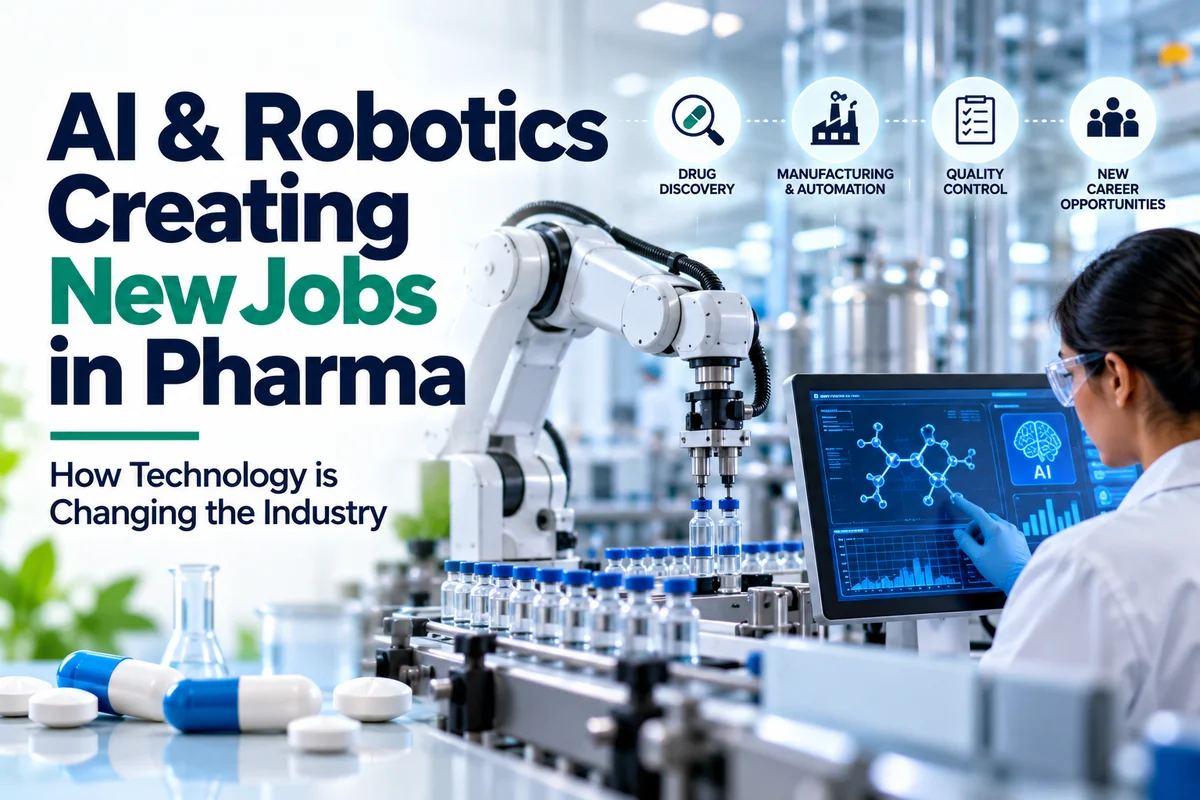
It is increasingly being explored across the pharmaceutical value chain—from drug discovery and clinical research to manufacturing, quality control, supply chains and commercial operations.
The Department of Pharmaceuticals highlighted the role of AI and emerging technologies across drug discovery, development and regulatory science during a government webinar earlier this year.
At India Pharma 2026, policymakers and industry leaders also discussed AI, CRDMO and next-generation technologies as part of the transformation of India's pharmaceutical ecosystem.
This means the future pharmacist or pharmaceutical professional may need to understand much more than medicines and manufacturing processes.
Where Is AI Already Making an Impact?
AI can potentially assist pharmaceutical companies in several areas.
1. Drug Discovery
Drug discovery traditionally involves years of research, experimentation and screening.
AI can analyse enormous datasets and help researchers identify promising molecules, predict molecular properties and prioritise candidates for further investigation.
This does not eliminate the need for scientists.
Instead, it can give researchers better tools to make decisions faster.
The emergence of dedicated AI roles in pharmaceutical research is already visible. For example, Amgen recently advertised an India-based role focused specifically on agentic AI in discovery chemistry, combining computational science with medicinal chemistry.
2. Pharmaceutical Manufacturing
The factory floor could see some of the most visible changes.
Modern pharmaceutical plants are increasingly adopting:
Robotics
Industrial IoT
Automated inspection
Predictive maintenance
Real-time process monitoring
Automated packaging
Digital batch records
AI-based analytics
The objective is not simply to reduce the number of workers.
The bigger objective is to make production more consistent, predictable and traceable.
Industry experts describe the transition toward connected, data-driven and highly automated pharmaceutical manufacturing as part of the broader Pharma 4.0 movement.
3. Quality Control Could Become More Digital
Quality control is one of the most important functions in pharmaceutical manufacturing.
AI and automation can assist with tasks such as:
Visual inspection → Data analysis → Anomaly detection → Predictive monitoring → Laboratory workflows
Connected laboratory systems are also becoming increasingly important.
Modern laboratory informatics platforms can connect instruments, analytical data and electronic records, improving traceability and reducing manual data handling.
However, pharmaceutical quality systems cannot simply hand decisions over to an algorithm.
Human review, validation, data integrity and regulatory compliance remain critical.
4. Robots Could Take Over Repetitive Tasks
Robotics could become increasingly common in areas such as:
Packaging
Material handling
Warehouse operations
Sample preparation
Automated laboratory processes
Visual inspection
Sterile manufacturing
Sorting and movement of products
These are precisely the kinds of repetitive or highly controlled tasks where machines can provide consistency.
But someone still needs to program, maintain, validate, monitor and manage those systems.
That creates new career opportunities.
The New Jobs Emerging in Pharma
The biggest change may therefore be in the type of jobs available.
Instead of simply asking whether AI will replace pharmacists, engineers or scientists, the more useful question is:
What new skills will pharmaceutical companies need?
Some emerging and expanding roles include:
AI & Pharma Data Scientist
Professionals who understand pharmaceutical datasets and can build or interpret machine-learning models.
Computational Drug Discovery Scientist
Scientists who combine chemistry, biology and computational methods to identify and evaluate potential drug candidates.
Pharma Automation Engineer
Engineers responsible for automated production lines, robotics, sensors and control systems.
AI Validation Specialist
Professionals who evaluate whether AI systems used in regulated pharmaceutical environments are reliable, validated and compliant.
Digital Quality Specialist
Experts who understand both pharmaceutical quality systems and digital technologies.
Data Integrity Specialist
Professionals responsible for ensuring pharmaceutical data remains accurate, traceable and secure.
Robotics & Manufacturing Engineer
Engineers who design, operate and maintain robotic systems used in pharmaceutical production.
AI Product Manager
Professionals who translate pharmaceutical business problems into practical AI solutions.
A New Opportunity for Pharmacy Graduates
This transformation could be particularly interesting for B.Pharm, M.Pharm and pharmaceutical science graduates.
A pharmacy student does not necessarily need to become a software engineer.
Instead, there is an opportunity to develop a combination of:
Pharma + Data + AI + Regulatory Knowledge
For example, a pharmacist who understands pharmaceutical manufacturing and also knows how to work with data and AI systems could potentially occupy a valuable position between traditional pharma teams and technology teams.
This hybrid skill set could become increasingly valuable.
The Future May Belong to "Hybrid" Professionals
Imagine a pharmaceutical manufacturing plant five years from now.
A production pharmacist may monitor an AI-powered dashboard rather than manually examine every production parameter.
An engineer may supervise dozens of automated machines.
A quality professional may review AI-generated anomaly reports.
A data scientist may identify a potential production problem before a batch fails.
A regulatory professional may evaluate whether an AI system meets compliance requirements.
The common factor?
Humans are still involved—but their work becomes more technology-driven.
AI Will Not Automatically Replace Human Expertise
There is an important distinction between automation of tasks and replacement of professions.
A machine can analyse thousands of data points.
But pharmaceutical professionals still need to understand:
Patient safety
Drug quality
Manufacturing processes
Regulatory requirements
Scientific context
Risk
Ethical considerations
Recent industry discussions have emphasised that AI adoption in pharma needs to augment human expertise rather than simply remove it. Workforce digital fluency and understanding AI's limitations are becoming increasingly important.
This is particularly important because pharmaceutical manufacturing is a highly regulated environment.
An AI system cannot simply make an unexplained decision about a medicine and be accepted without validation and oversight.
The Skills Pharma Professionals Should Start Learning
For students and professionals looking ahead, some skills could become increasingly useful.
For Pharmacy Students
Consider learning:
Data analytics
Excel and advanced spreadsheets
SQL
Basic Python
AI fundamentals
Pharmaceutical informatics
Regulatory technology
Digital quality systems
For Engineers
Focus areas could include:
Industrial automation
Robotics
PLC/SCADA
Industrial IoT
Machine learning
Manufacturing analytics
Digital twins
For Pharma Scientists
Useful areas include:
Computational chemistry
Bioinformatics
AI-assisted drug discovery
Statistical analysis
Machine learning
Scientific data management
India's Opportunity
India has a particularly interesting opportunity because it already possesses a large pharmaceutical manufacturing ecosystem.
The government has been promoting domestic pharmaceutical manufacturing capabilities and technology adoption through initiatives including the Production Linked Incentive schemes.
The next step could be to combine India's established manufacturing strengths with AI, automation, robotics and advanced analytics.
EY-Parthenon has described the emerging pharmaceutical model as one where novel science, AI and manufacturing capabilities increasingly work together, creating new opportunities for India.
The Biggest Challenge: Skills
Technology can be purchased.
Skills cannot.
Pharmaceutical companies may invest millions in automated machinery and AI platforms, but those systems still require people who understand how to implement, validate and operate them.
That makes upskilling one of the biggest challenges—and opportunities—for the industry.
Pharma colleges may also need to rethink traditional curricula.
Tomorrow's pharmaceutical professional may need a stronger understanding of:
Medicine + Manufacturing + Data + Technology
PharmaNation View
The debate about AI and employment is often presented as a simple choice:
Humans vs Machines.
Pharmaceutical manufacturing suggests a different possibility.
The future may be:
Humans + Machines.
Robots can handle repetitive physical tasks.
AI can process enormous amounts of information.
Automation can improve consistency.
But pharmaceutical professionals provide scientific judgement, regulatory understanding, ethical oversight and accountability.
The professionals who learn to work with these technologies could be better positioned than those who ignore them.
The Bottom Line
AI and robotics are likely to change pharmaceutical jobs—but change does not necessarily mean fewer jobs.
It could mean different jobs.
The pharmacist of the future may understand AI.
The quality professional may work with automated analytics.
The manufacturing engineer may supervise intelligent robotic systems.
The scientist may use AI to accelerate drug discovery.
And the most valuable professionals may increasingly be those who can speak both “pharma” and “technology.”
For India's pharmaceutical industry, that could turn the AI revolution into not just a productivity story—but a new employment and skills opportunity.
PharmaNation will continue to track how AI, robotics, automation and digital technology are reshaping India's pharmaceutical industry and its workforce.
This article discusses emerging industry trends and potential career opportunities. Specific job
The editors of this publication. Replace with your real editors in News Desk → Authors.
More from this section

The Practical Antibiotic Handbook by PharmaNation ( DOWNLOAD E-BOOK )
Drug Recall in India: What Happens When a Medicine Fails a Quality Test?
Drug Regulations in India: Rules, CDSCO, Schedules & Pharmacy Compliance